
What Victoria’s Political Donation Laws Mean for Democracy
Recently I announced my intention to contest the seat of Nepean here on the Mornington Peninsula at the Victorian election on 28 November 2026.
As I was getting my campaign ready to launch, I began delving into the regulations around political donations to make sure I understood the rules and, importantly, that I’m compliant.
What I discovered was a lot more complicated than I expected… And it got me thinking about something much bigger than the paperwork involved in running an election campaign.
Political donations are one of those subjects that can make people’s eyes glaze over.
Caps. Disclosure thresholds. Nominated entities. Public funding. Constitutional challenges.
But underneath all the legal language is a pretty simple question:
Who gets a fair chance to be heard at an election?
As the independent candidate for Nepean, I think this is a question worth asking, not because of any particular political party or candidate, but because the rules governing how political campaigns are funded can strengthen or weaken our democracy.
What are political donation laws actually for?
Political donation laws are intended to do two important things.
First, they should prevent wealthy individuals, corporations or other interests from gaining disproportionate influence simply because they can spend more money.
Second, they should make political funding transparent, so voters can see who is financially supporting candidates and parties.
Both are important democratic principles.
But there is a third principle that matters too: the rules should not make it unnecessarily difficult for new candidates and independent voices to compete with established political organisations.
That became a very real issue in Victoria.
What happened earlier this year?
In April, the High Court of Australia unanimously ruled that Victoria’s existing political donation regime was unconstitutional.
The case was Hopper v Victoria, brought by Paul Hopper and Melissa Lowe. The Court found that Part 12 of Victoria’s Electoral Act impermissibly burdened the constitutional freedom of political communication.
The problem centred on something called a nominated entity.
Under the old system, political donations were generally capped. But registered political parties could receive money from their nominated entities without that money being subject to the same cap.
There were three such entities established under the relevant transitional rules, associated with the Liberal Party, Labor Party and National Party. The High Court noted that these entities were already well-capitalised before the donation cap came into operation.
Put simply, an independent candidate could be subject to a donation limit while the established major parties had access to a much larger pool of money through a mechanism that wasn’t available on the same terms to new political entrants.
That creates an uneven playing field.
The Court didn’t simply remove the particular exemption. It found the whole of Part 12 invalid because the provisions couldn’t be separated in a way that fixed the constitutional problem.
For a short period, Victoria effectively had no political donation caps or disclosure requirements at all.
That clearly wasn’t a sustainable solution either.
So what’s changed?
Victoria’s Parliament subsequently passed new legislation, which reinstates donation caps and disclosure requirements, bans foreign donations and anonymous donations above the relevant threshold, and restores political funding arrangements.
For the period leading up to the November state election, the general donation cap is currently $5,190 per donor, with donations of $1,290 or more subject to disclosure. After the election, the general cap increases to $7,740.
There is also an important change for new entrants.
Eligible new political parties and independent candidates who have not previously received public funding can register as new entrants and receive up to twice the general donation cap from a single donor.
That’s an improvement.
The new laws have also removed the old nominated-entity arrangements that created the particular imbalance examined by the High Court.
But does that mean the playing field is now completely level?
I’m not convinced it does.
The challenge for independents
An established political party is not simply a candidate on a ballot paper.
It has a brand that may have existed for generations. It has members, volunteers, existing infrastructure, fundraising networks, databases, campaign experience and, importantly, access to public funding if it meets the requirements.
An independent starting a campaign has to build most of that from scratch.
Victoria does provide public funding to eligible independent candidates, but eligibility generally requires receiving at least 4% of first-preference votes or being elected.
That means public funding can help after you’ve demonstrated electoral support.
It doesn’t necessarily help you build the campaign that gets you there.
If you want to see just how much built-in advantage that creates before an independent even gets to that 4% mark, this breakdown of the taxpayer-funded benefits that flow to incumbents is worth a look: Wall of Advantage.
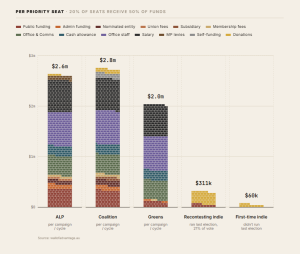
And this is where I think we need to have a bigger conversation about political finance.
Rules can protect democracy… or unintentionally restrict it
I don’t believe political donations should be a free-for-all. I don’t want elections to become auctions where the person with the deepest pockets gets the loudest voice.
But equally, I don’t think we should create a system where the cost of complying with the rules, combined with limits on legitimate fundraising, makes it harder for ordinary people to put themselves forward.
Independent candidates are an important part of our democratic system. So are established political parties.
Democracy needs both.
Political donation laws should therefore aim for three things: transparency, limits on undue influence, and a genuinely competitive electoral environment.
The High Court case was a reminder that these principles have to coexist.
For me, the question isn’t whether the major parties are good or bad. Politics is much bigger than that.
The question is whether the rules of the game allow voters to hear a genuine range of voices before they decide who should represent them.
Because ultimately, political donation laws aren’t really about money.
They’re about power, participation and whose voice gets heard.
And that makes them a democratic issue for every Victorian, whether you belong to a political party, support an independent, or have never donated a dollar to a political campaign in your life.