
The most powerful thing you do at an election, and nobody explains it
Your vote doesn’t die when your first choice loses. Here’s what actually happens to it, and why nobody tells you.
I’ve handed out how-to-vote cards at a few elections now. You stand near the booth, you smile, you offer people a ‘card’, and you watch. And the thing I keep noticing, the thing I can’t quite unsee, is how many people walk in unsure about what they’re about to do.
Not unsure who to vote for. Unsure how voting actually works. What it means to number every box. What happens to your vote after your first choice. These are not silly people. They’re nurses and tradies and retired teachers, people who run complicated lives competently every day. They were just never properly told.
So let me tell you the one thing about your vote that nobody seems to say out loud.
When you vote for the seat of Nepean, or for any member of the lower house (the Legislative Assembly in Victoria) seat in an election, you have to number every box. One next to your favourite, then two, three, and so on, all the way down. These are your preferences. Most people think the second and third numbers are a formality, a bit of paperwork you do to keep your ballot valid. They’re not. These second, third, fourth (and sometimes beyond) preferences decide who wins.
Here’s what actually happens. In Victoria’s case the Victorian Electoral Commission count everyone’s number ones first, their first preferences. If no candidate has more than half, the candidate in last place is knocked out, and here’s the part that matters: those votes don’t vanish and they’re not wasted. Every ballot that had that candidate as number one gets passed along to whoever the voter put next in second place, among the candidates still in the running. Then they count again. Still nobody over half? Knock out the new last place, pass those votes to the next preference, count again. Around it goes until somebody clears fifty per cent plus one vote. Until they have ‘won on preferences’.
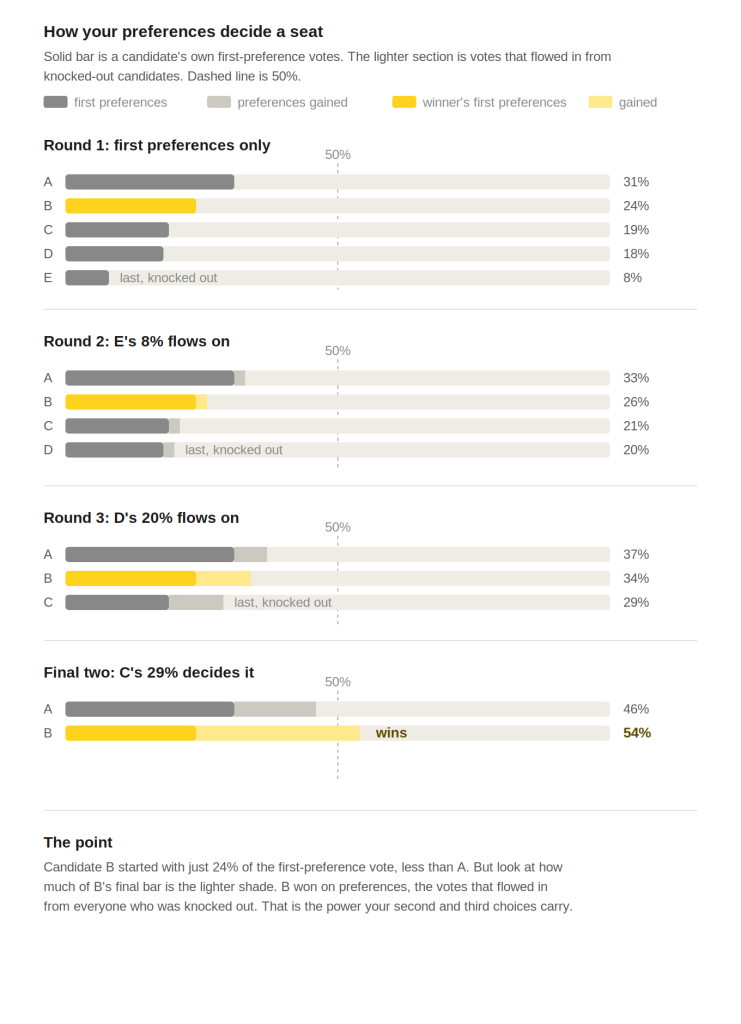
Read that again, because it’s the bit they never spell out. Your vote does not die when your first choice loses. It transfers. It keeps working, keeps having a say, right up until the final two candidates are standing. A vote for someone who can’t win is not a wasted vote. It’s a vote that gets to speak twice, three times, as many times as it takes for a candidate to get enough votes to get more than 50% of votes .
Which means the order you number those boxes is not paperwork. It’s power. Put a candidate you can’t stand at number five and someone you can live with at number three, and you’ve told the counters exactly how to handle your vote when the knockouts begin. People who understand this vote with their whole ballot. People who don’t, hand back their power they didn’t understand they had.
Now… I’ve worked in financial services. I’ve been in an industry where disclosure is not a nice-to-have, or a favour you do the client when you’re feeling generous. It’s the minimum. You tell people what you’re charging, where their money is, and what’s in it for you, and you do it whether they ask or not. Hide the numbers, call it private, and you don’t get a slap on the wrist. You lose your licence. The whole thing runs on one stubborn idea: the person whose money it is has a right to see how the decisions get made.
So I’ll admit I find it strange that we accept so much less from the people who spend our taxes and write our laws. The most powerful thing you control as a voter, your preferences, is the thing nobody bothers to properly explain. Nobody designed it that way. The system just stopped explaining itself a long time ago, because for the most part it didn’t have to. Most of us were only ever going to turn up once every few years, take the card, pick from a menu someone else wrote, and go home with our democracy sausage. Clarity took effort. Fog was free.
I’ve started to think the Fog is what people might mean when they say they’re sick of politics. Not the arguments. Not even the broken promises, which you can at least see and judge for yourself. The Fog is the creeping feeling that the important stuff happens in rooms you’ll never sit in, decided by people who answer to other people, and your job is to stay quiet between elections and grateful during them. People aren’t switched off because they’re lazy. They’ve correctly worked out they’re being kept in the dark, and nobody enjoys being treated like a mushroom.
Here’s the quiet thing, though. Around the country, and right here on the Peninsula, groups of people have started doing politics with the lights on. Publishing who funds them and their campaign, in full, not just the minimum detail. Holding public meetings before the vote, not the press release after it. Explaining how things work instead of hoping you won’t ask. None of this is radical. It’s just showing your working. It only looks radical because we’ve grown so used to the dark that someone reaching for the light-switch seems like a stunt.
I’m not going to pretend I’ve got all of this worked out. I don’t. I’m someone who has stood at enough booths, written enough letters to the local paper, and sat through enough community meetings to have become a bit obsessed with how the system actually works, where the Fog comes from, and what it looks like when someone clears it. I keep circling back to one question: if we don’t understand the power we already hold, how can any of us vote powerfully?
There’s a second house on that ballot paper too, the upper house (the Legislative Council in Victoria), and the rules there may be changing for this very election. That’s a story for next time, once I can tell it to you straight…
I think you can be trusted with the truth. Let’s see where that takes us.