
In the upper house, your preferences can be handed to someone you’d never choose
Tick one box above the line in the Victorian upper house, and the party decides the rest for you. Here’s how that works, and who’s already trying to use it.
Picture yourself in the polling booth this November. You care about climate change, so when you see a party on the upper house ballot called Climate Action Now, you tick the box above the line and walk out feeling like you did the right thing. What you can’t see on that ballot paper is where your preferences flow, because in Victoria’s upper house, once you’ve ticked that one box, that party decides the rest for you.
Right now there’s a real party seeking exactly that name. The Victorian Electoral Commission has received an application to register a party called Climate Action Now, and its proposed registered officer is Monica Smit, founder of the anti-lockdown group Reignite Democracy Australia. It’s worth noticing, as the election analyst Antony Green has, that the people registering these parties aren’t generally known for campaigning on the issues their party names suggest. The application is still open to objection until 18 July, so it isn’t registered yet. And it isn’t the only party of its kind seeking a spot on the ballot. But the fact that sormeone can even attempt this, legally and in plain sight, tells you something is badly wrong with how our upper house works.
Let me explain it, because once you see it, you’ll understand why I keep going on about the fog.
You might remember from last year’s federal election that voting above the line means voting for a party, and below the line means voting for individual candidates. The Victorian upper house looks identical. Same big ballot, same line, same choice. But it behaves in a way that would not be allowed at a federal election, because the Senate was made more transparent a decade ago and Victoria is still waiting to catch up.
Here’s the difference, and it’s everything. In the Senate, when you vote above the line, you number the parties in your own order, and your preferences flow the way you chose. You stay in control the whole way down. In the Victorian upper house, you put a single 1 next to one party, and that is the last decision you get to make. From there your preferences flow according to that party’s group voting ticket, a running order the party lodges in advance, that you never see on the ballot and almost certainly never went looking for. You pick the party. The party picks everyone else.
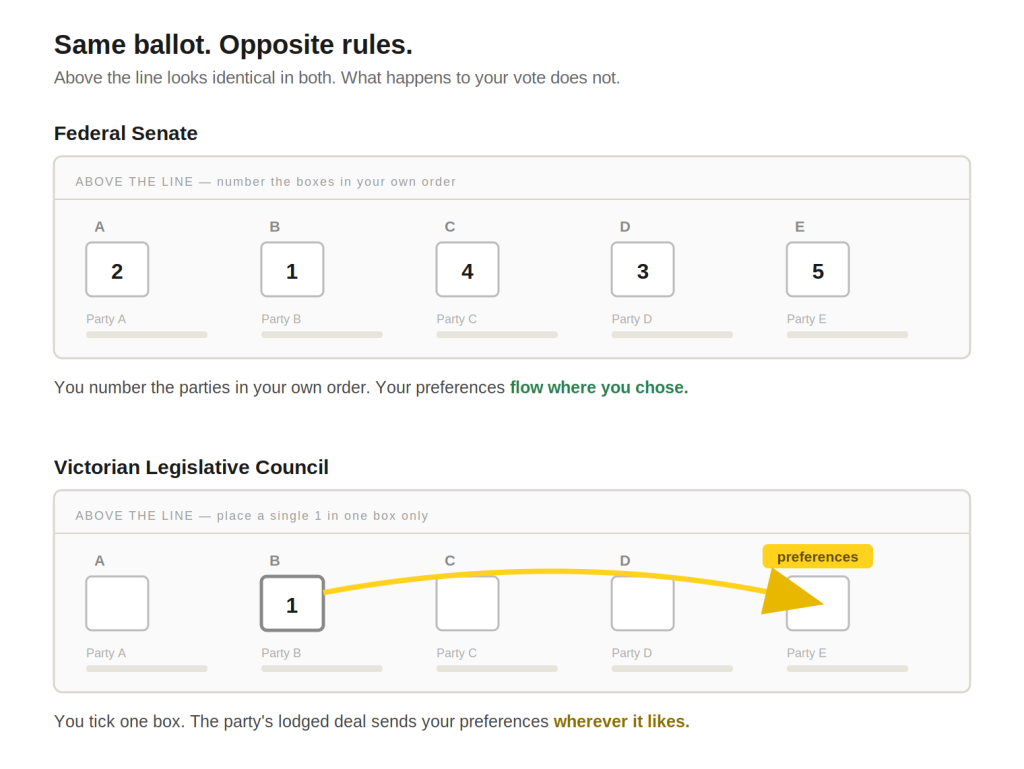
That is what makes the trick possible. When you vote 1 above the line for a party, you are not just giving them your first preference. You are handing over all your other preferences to be passed along wherever their lodged ticket sends them, which might be a party you have never heard of, or one you would actively cross the road to avoid. You would have no idea, because the ballot paper doesn’t tell you and can’t. The deal is lodged with the electoral commission and technically public, but published in a form almost no ordinary voter is ever likely to read.
And before anyone decides this is a story about one side of politics playing dirty, it isn’t. This mechanism has been gamed from every direction over the years. Antony Green’s own record of past cases shows it has often been used to help Labor and to block the Greens, as well as by micro-parties of every stripe. The problem isn’t a party. The problem is a system built so that anyone willing to work the machinery can redirect other people’s preferences, and the voter is the mark every time.
The scale of it is what should really bother you. This is not a fringe quirk affecting a few ballots. Antony Green has shown that more than ninety per cent of above-the-line votes in the Victorian upper house end up locked into pre-arranged group voting tickets. In his words, that hands political power to a small cabal of party negotiators who arrange the deals, and distorts the proportional result the chamber is supposed to produce. He has documented candidates winning seats off less than one per cent of the vote, elected not by voters but by the arithmetic of preference trades.
There is a way to protect your voice this election, and it’s the same lesson as always: do the work and take back your powerful preferences. If you vote below the line, numbering the individual candidates yourself, you decide where every one of your preferences goes, exactly as you do in the lower house. It takes longer. You number a stack of boxes instead of ticking one. But that’s the difference between choosing where your preferences goes and letting a stranger decide for you. The whole trick runs on the fact that ticking one box is quick and most of us are busy.
New South Wales scrapped group voting tickets in 2000, the Senate in 2016, South Australia in 2017, Western Australia in 2021. Of the parliaments that still have an upper house elected this way, Victoria is the last one clinging to it. (Queensland sidestepped the whole problem by not having an upper house at all.) Victoria’s own parliamentary committee has recommended getting rid of GVTs, not once but twice.
And here’s the part that should worry you if you care about this being fixed in time. The Electoral Commission has said the law needs to be in force by August for any change to be ready for November’s election, and it underlined that word immediately itself. Parliament doesn’t sit again until the last week of July. As things stand today, no legislation has appeared, nearly four months after the commission asked for it.
This is the upper house I promised I’d tell you about. The same ballot paper as the Senate, the opposite rules underneath, and a loophole hiding in the fine print that every serious expert in the country has been asking Victoria to close.
You can be trusted to direct your own preferences. Your vote is your voice. And a system that lets a party take your voice and put its own words in your mouth isn’t a fair one. You can be trusted to direct your own vote. Number below the line, my friends!