
One fix down, one to go: what the Victorian Parliament just changed about your upper house vote
Victoria has scrapped the preference deals that let parties send your vote wherever they liked. Here’s what you’ll do differently in November, and the loophole they still haven’t closed.
A few weeks ago I wrote about a con hiding in the Victorian upper house. If you vote above the line on the upper house ballot paper, you ticked one box above the line. That party then decided where all your other preferences went, through a secret deal. I said the rules might be about to change. Well, they changed last night (11/08/2026).
The Victorian Parliament has now passed a law scrapping group voting tickets (GVTs), and it’s just waiting on the Governor’s signature to be final. It’s a genuinely good day for anyone who thinks your vote should do what you tell it to. So let me explain what actually changed, what you need to do differently on the ballot in November. And the one part that still needs fixing.
First, the simple version of how the upper house works, because it trips almost everyone up. You get one big ballot paper with a line across it. Above the line, you’re voting for parties. Below the line, you’re voting for individual candidates. Same paper, two ways to do it, and they behave differently.
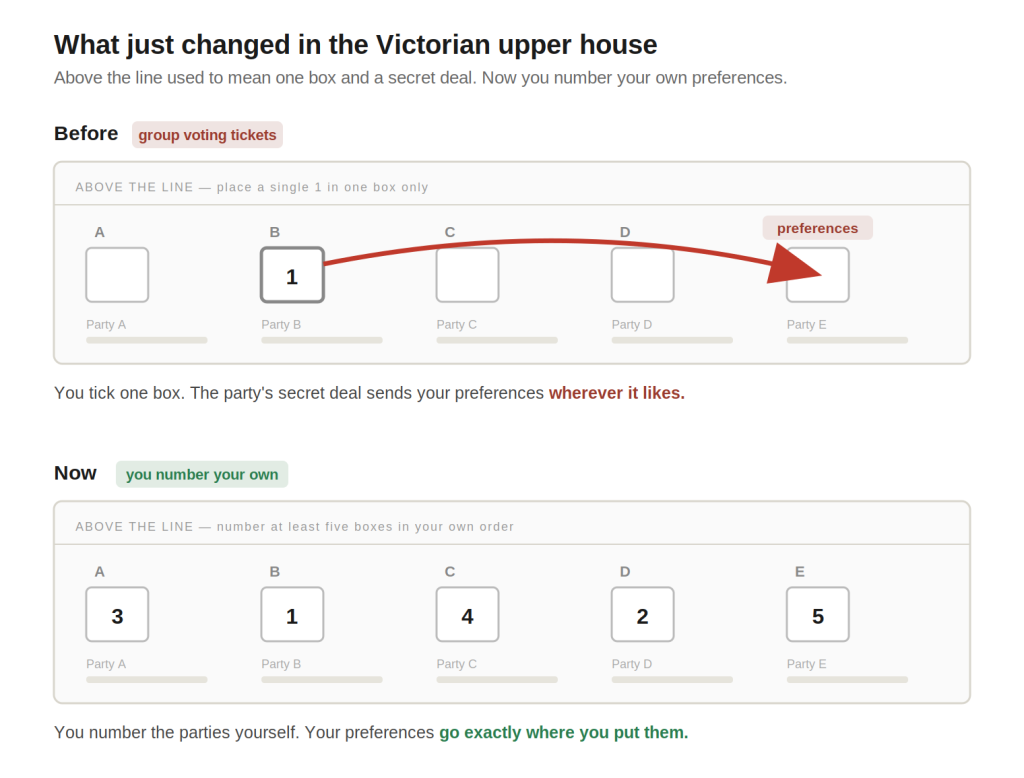
Here’s what’s changed. Under the old system, voting above the line meant putting a single 1 next to one party, and that was the last say you got. The party’s GVT took over from there and sent your preferences wherever that party had arranged, often to people you’d never choose. That’s the bit that’s gone.
Under the new rules, when you vote above the line you number at least five parties, in your own order of preference. One, two, three, four, five, however you actually feel about them. Your preferences then flow the way you numbered them. You can number more than five if you want. And if you slip up and number fewer, your vote still counts as long as you’ve marked a clear first choice.
That is the whole difference, and it’s a big one. The deals are dead. No more preference whispering. No more candidates sneaking into Parliament on half a per cent of the vote because a chain of secret arrangements carried them over the line. From November 2026, the only preferences in the count are the ones you actually write yourself. Victoria was the last place in the country still doing it the old way, and now that’s over.
If you’d rather control everything yourself, you can still vote below the line, numbering individual candidates in your own order, at least five of them. Above the line you pick the parties and the order, and each party decides which of its own people your vote helps first. Below the line, you decide all of it, candidate by candidate. Both are valid. The difference is just how much of the detail you want to hold in your own hands.
So that’s the win. Your voice is yours again. Which brings me to the part they haven’t fixed.
You might have heard about parties turning up with names designed to fool you. A party called something like Climate Action Now, run by people who campaign against exactly that. The idea is simple and cynical: pick a name that sounds like a cause a lot of people care about, and hope enough of them tick it without looking closely.
Here’s the uncomfortable truth. Scrapping GVTs makes this trick much weaker, but it doesn’t kill it. In the old days, a deceptive name was devastating, because it didn’t just grab your first preference, it handed the party your entire ballot to redirect. Now, at least, they can only get the one preference you actually gave them. Your others are safe because you control them. But that first preference still matters, and if a misleading name talks you into giving your number one to a cause that’s the opposite of what you believe, that’s a real vote, quietly wasted on the very thing you were trying to vote against.
And the law does almost nothing to stop it. The rules about what a party can call itself are surprisingly narrow. The VEC can knock back a name for being too long, or obscene, or for copying an existing party, or for falsely implying a link to another party or a seat in Parliament. What it cannot do is refuse a name simply because it misrepresents what the party actually stands for. Lying about your policies isn’t on the list. So the commission’s hands are tied. It can’t say no, even when the name is clearly misleading.
I’ll be fair about this. It’s not a simple thing to fix. Working out when a party name is genuinely misleading, rather than just a difference of opinion about what a word means, is hard. And we’d want it done carefully so the commission isn’t left refereeing what every party really stands for. But hard is not the same as impossible. Parliament just showed it can move fast on electoral law when it decides something matters. The will was there for one fix. It can be there for the next.
And here’s the thing worth noticing about who pushes these unglamorous repairs. The rules about party names are written by the parties themselves, and closing a loophole that only ever fools voters, never the operators, is not high on anyone’s list when it might cost them a seat. Fixes like this tend to come from the edges, from independents and crossbenchers who have no back room to protect and whose only real constituency is the voter staring at a confusing ballot. That’s usually who has to stand up and say the quiet part out loud.
So: one fix down. Your preferences are your own again, and that’s worth celebrating. But there’s one to go, and it’s the one that still lets someone put a comforting name on a nasty surprise. Keep your eyes open in November. Read the name, then look past it.
You can be trusted with the truth. It’d be nice if your ballot paper agreed.